
Solar panel batteries: how to size them right first time
RSS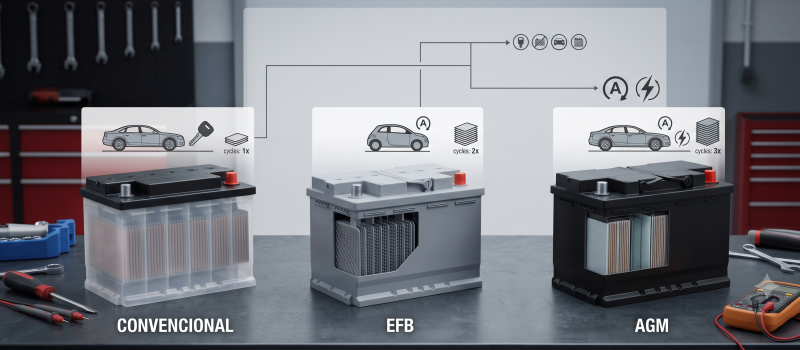
In an off-grid solar installation, the battery is the component people get wrong most — and the most expensive to get wrong: it will do a full cycle every day for years. Here's the method to size it right first time.
⚡ The essentials in 20 seconds
- Here car batteries won't do: you need deep-cycle.
- Size it in 4 steps: consumption × days of autonomy ÷ depth of discharge.
- Lead uses 50% of its capacity; lithium, 80-90%.
- A good regulator (MPPT) and thick cables are part of the system.
First: car batteries won't do here
A starting battery withstands 50-80 deep discharges in its whole life; a solar installation asks for 365 a year. The real options are deep-cycle batteries: deep-cycle AGM, gel, stationary (OPzS/OPzV for serious installations) and lithium LiFePO4. Fitting a starting one "to begin with" is throwing money away: it won't last a year.
The sizing method (4 steps)
- Daily consumption: add up watts × hours of each appliance. Example of a country cabin: A++ fridge (600 Wh), LED lights (100 Wh), TV and router (300 Wh), pump (200 Wh) ≈ 1.2 kWh/day = 100 Ah/day at 12 V.
- Days of autonomy: 2-3 days without sun in the south, 3-4 in the north, to cover cloudy spells.
- Depth of discharge: lead (AGM/gel/OPz) use 50%; lithium, 80-90%.
- The maths: 100 Ah/day × 3 days ÷ 0.5 = 600 Ah in lead — or ÷ 0.85 ≈ 350 Ah in lithium.
Lead or lithium: the cost per cycle
Gel at ~1,500 cycles at 50% and lithium at ~4,000 at 80% give surprisingly similar costs per kWh stored today. Lithium wins on weight, efficiency (95% versus 80%) and fast charging — it makes better use of every hour of sun; stationary lead still wins on upfront cost and simplicity at 12/24 V. Above 3 kWh a day, it's worth getting figures for both and comparing over 10 years, not just the purchase price.
The regulator and wiring count too
The best battery performs poorly with a poor regulator or wiring. An MPPT regulator makes considerably more of the panel than a PWM and pays for itself the first year in mid-sized installations. And tight cable cross-sections cause voltage drops that the regulator reads as "battery full", leaving it chronically half-charged. Size the cable generously and protect each run with its fuse.
12, 24 or 48 V: which bank voltage
The more consumption, the more it pays to raise the bank voltage. As a guide: 12 V for small installations (a cabin, a motorhome); 24 V for weekend homes with appliances; 48 V for permanent homes or high consumption. Raising the voltage reduces the current for the same power, which allows thinner cables and fewer losses. Defining the voltage before buying battery and inverter saves redoing the installation when you expand.
Temperature rules the bank's life
Lead batteries lose life with heat and capacity with cold; lithium ones can't be charged below 0 °C without a BMS to control it. A well-placed bank — shaded, ventilated and protected from frost — lasts years longer than one exposed to the elements. In serious installations, the battery room is cared for as much as the panels.
The costly mistakes
- PWM regulator with a large bank: an MPPT performs far better.
- Mixing batteries of different ages in the same bank: the old one drags down the new.
- Wiring with tight cross-sections: voltage drops and incomplete charges.
- Lithium without a low-temperature BMS if the installation freezes in winter.
- Sizing without days of autonomy: the first cloudy spell leaves you without power.
Frequently asked questions
Can I use a car battery for my solar installation?
No: a starting battery doesn't withstand the daily deep discharges of a solar installation and fails within months. You need a deep-cycle: deep-cycle AGM, gel, stationary or lithium.
How many batteries do I need?
It depends on the daily consumption, the days of autonomy you want and the technology. The rule: daily consumption × days ÷ depth of discharge (50% in lead, 80-90% in lithium). With those figures we size the bank for you.
Lead or lithium for an off-grid installation?
Stationary lead wins on upfront cost and simplicity; lithium, on weight, efficiency and cycles. Above 3 kWh a day it's worth comparing the 10-year cost, not just the purchase price.
Which regulator do I need, PWM or MPPT?
An MPPT makes far more of the panel than a PWM and pays for itself the first year in mid-sized or large installations. On very small installations with tight-voltage panels a PWM can do, but for most cases the MPPT is the profitable option.
Shall we size your installation?
Tell us your daily consumption and location, and the technical team returns the configuration with price and lead time in under 4 working hours.
See deep-cycle batteries and request a quote →