
How long a car battery lasts (and 7 habits that extend it)
RSS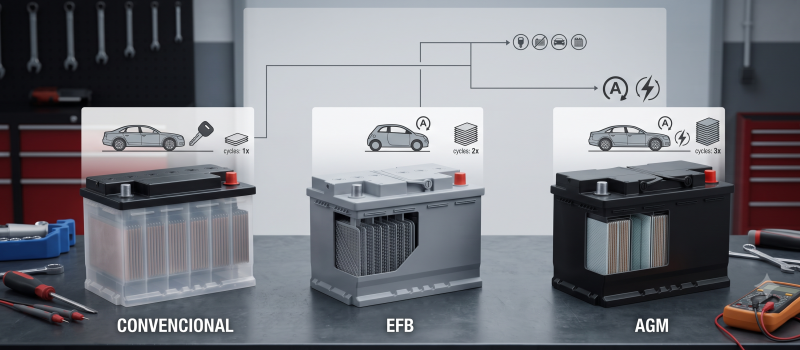
The honest answer: between 2 and 10 years. The Spanish average is around 4-5, but the range depends on three factors you can control — and one you can't (your climate).
⚡ The essentials in 20 seconds
- Average in Spain: 4-5 years; real range from 2 to 10.
- What shortens life most: heat, short trips and deep discharges.
- Heat kills; cold merely reveals the damage already done.
- 7 simple habits extend it noticeably.
What dictates your battery's life
- Technology: conventional 3-5 years, EFB 4-6, AGM 6-8. The full comparison is in the battery guide.
- Climate: heat accelerates corrosion and evaporates the electrolyte; cold only reveals the damage. The same battery lasts one or two years less in a hot region than in a cool one — we explain it in the heat post.
- Type of use: trips under 15 minutes don't replace what the start-up used. The battery lives half-discharged and sulphates.
Why heat does more damage than cold
It seems contradictory, because the battery fails in winter. But summer heat is what causes the wear: it accelerates plate corrosion and evaporates water from the electrolyte, permanently reducing capacity. When the first cold arrives, that already-weakened battery has to deliver more current (the engine cranks harder with thick oil) with less margin: that's when it "dies". The damage was done in August; it only shows in December.
7 habits that extend its life
- Take a 30-45 minute drive every couple of weeks if you usually only do short trips.
- Use a maintenance charger if the car sleeps for weeks.
- Park in the shade in summer whenever you can.
- Don't run equipment (radio, lights, USB) with the engine off.
- Keep the terminals clean and tight: a sulphated terminal forces the battery to work harder.
- Check the voltage once a year from the third year (12.4 V at rest = attention).
- If you suffer a deep discharge, give it a full recharge that same week.
Signs it's entering its final year
Sluggish cold starts, lights that flicker at idle, over 4 years old with an intense summer behind it. None is urgent on its own; two together are. If the multimeter reads under 12.4 V at rest with the battery cold, start planning the replacement before it strands you. How to act when the moment comes: flat battery, what to do.
How to read the manufacture date
Knowing your battery's real age (or that of the one you're buying) avoids surprises. Almost all carry a code stamped on the lid or a side: sometimes a direct date, and often a letter (the month) plus a number (the year), or vice versa. A "new" battery made over a year ago and stored without maintenance has already lost part of its life before being fitted — the reason we distrust "bargain" old stock.
Lithium plays in another league
Lithium (LiFePO4) batteries for leisure, solar or marine use aren't measured in years but in cycles: between 2,000 and 5,000 full charges, versus the few hundred of a lead battery. In intense daily use they can last 10-15 years. They don't replace the car's starter battery, but when the application is deep-cycle, their lifespan completely changes the cost equation.
Three myths about lifespan
- "Charging your phone drains the battery": a minimal load with the engine running is irrelevant; the problem is consuming with the engine off.
- "The more expensive, the longer it lasts": the right one for your car and climate lasts longer, not simply the dearest.
- "If it starts, it's fine": a battery can start and be at 40% of its capacity, one cold day from stranding you.
Seasonal maintenance
In summer, shade and check the level if it allows it; in autumn, a voltage check before the cold; in winter, avoid discharges and don't leave consumers on with the car parked. A quarter of an hour at each change of season extends life more than any miracle additive.
Frequently asked questions
How long does a car battery last on average?
In Spain, between 4 and 5 years on average, with a real range of 2 to 10 depending on technology, climate and use. Quality AGM batteries reach 6-8 years; conventional ones, 3-5.
Does driving more extend battery life?
Trips that are too short don't let the alternator replace what the start-up used, so a slightly longer drive now and then helps. But driving in excess doesn't "over-charge": once full, the battery gains nothing.
Can you tell how much life is left?
A multimeter gives a hint (resting voltage), but the reliable test is a load test at a workshop, which measures real capacity under demand. From the fourth year, it's worth doing once a year.
Replace on your terms, not the tow truck's
Find your battery by number plate, with 24h shipping and home fitting in the main cities.
Find my battery →