The complete battery guide: types, how to choose and how long they last
RSS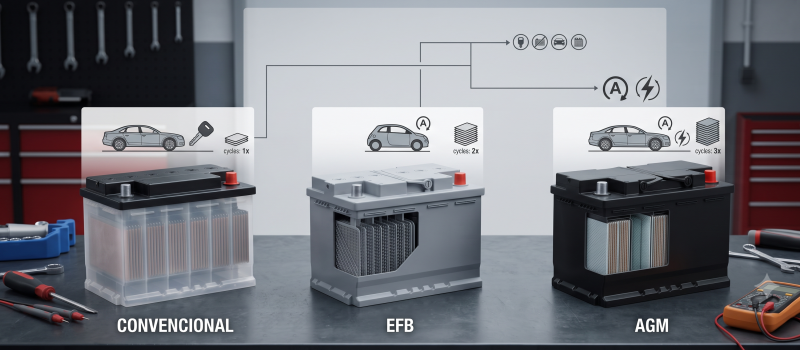
Choosing a battery seems simple — until you actually have to do it: technologies with acronyms (AGM, EFB, gel, lithium), capacities in amp-hours, measurements down to the millimetre, polarities, and prices ranging from €50 to over €900. This guide brings together everything you need to get it right first time — with links to our in-depth guides whenever you want to dig deeper.
⚡ The essentials in 20 seconds
- Never downgrade the technology: if your car came with AGM, the replacement must be AGM.
- Four facts define the right replacement: dimensions, Ah, cold-cranking current (CCA) and polarity.
- The average lifespan of a battery is 4-5 years; heat shortens it more than cold does.
- Price comes down to the technology, the CCA and who actually manufactures it — not the badge on the label.
- In a hurry? Search by number plate and compare only batteries compatible with your car.
What the battery actually does (and why it fails)
Your vehicle’s battery performs three jobs that we rarely think about — until one of them fails:
- Starting the engine: it delivers hundreds of amps for one or two seconds to turn the starter motor. It’s the most demanding task it performs.
- Stabilising the voltage: it smooths out the peaks and dips in the electrical system so the electronics — an ever-growing number of them — run on a clean, stable supply.
- Powering things with the engine off: alarm, central locking, clock, ECU memories… all keep drawing current even while the car sleeps.
Above all, it’s a wear component: every discharge-and-recharge cycle degrades its lead plates a little, and heat silently accelerates that corrosion. That’s why summer is its worst enemy, even though the failure almost always shows up with the first cold snap: heat causes the damage, cold just reveals it.
Battery types: which one suits each use
Technology is the first decision, and the most important one. Not every type suits every car, and getting it wrong is costly.
| Technology | What it’s for | Typical lifespan |
|---|---|---|
| Conventional lead-acid | Cars without start-stop, normal use | 3-5 years |
| EFB | Basic start-stop | 4-6 years |
| AGM | Advanced start-stop, regenerative braking, heavy electrical load | 6-8 years |
| Gel | Slow deep discharge: mobility, marine, solar | 6-10 years |
| Cyclic (deep cycle) | Motorhomes, boats, solar installations | Depends on cycles |
| Lithium (LiFePO4) | Premium deep cycle: minimal weight, maximum lifespan | 2,000+ cycles |
Conventional batteries are the tried-and-tested option: reliable and affordable for cars without a start-stop system. EFB batteries add extra reinforcement to withstand the constant restarts of a basic start-stop system. AGM batteries (absorbent glass mat) handle many more cycles and are compulsory in cars with advanced start-stop or brake energy recovery. Gel and cyclic batteries are built to be deeply discharged again and again — which would kill a starter battery —, while lithium is the premium choice for anyone who prioritises weight and lifespan.
The golden rule: never downgrade the technology. Fitting a conventional battery to a start-stop car destroys it within a few months, and on many models the start-stop system simply stops working. Upgrading can make sense (fitting an AGM to a heavily-equipped car that originally had a conventional battery), but downgrading never does.
You’ll find the extended comparison, including the start-stop compatibility table, in our guide EFB, AGM or conventional.
How to find out which battery your vehicle needs
Four facts — and only four — define the correct replacement:
- Dimensions (length × width × height in mm): the battery has to fit in its tray and be firmly secured. One that shifts around wrecks its plates through vibration.
- Capacity (Ah): the energy it stores. A reasonable margin for the replacement is ±10-15 % of the original. More amps won’t damage the car; fewer, on the other hand, shorten its lifespan and leave the starter underpowered.
- Cold-cranking current (CCA or EN): the amps it delivers in the cold. Never below the original figure, and especially important on diesels, which need more current to start.
- Polarity and terminal type: the positive terminal has to end up on the side the cable reaches. It sounds obvious, but it’s the number one reason for returns.
Don’t fancy tracking down all that information yourself? Our battery finder by number plate does it for you: enter your registration and it returns only the batteries that fit your vehicle, with dimensions and polarity already verified. And if you’d rather understand each acronym, you’ll find it explained in the battery glossary.
How long a battery lasts and what wears it down
The average lifespan is 4-5 years, but the real range runs from 2 to 10 depending on technology, climate and use. These are the four factors that shorten it the most:
- Sustained heat: speeds up internal corrosion and evaporates the electrolyte. The same battery lasts a year or two less in Seville than in Bilbao.
- Short journeys: drive for less than 15-20 minutes and the alternator never fully replaces what starting used up. The battery lives half-charged and sulphates.
- Deep discharges: every time you «left the lights on», it leaves a permanent scar on a starter battery, which isn’t designed to be drained flat.
- Long lay-ups: a parked car keeps drawing current. In three or four weeks it can finish off a battery that was already borderline.
7 habits that extend its life
- Take a 30-45 minute drive every couple of weeks if you usually only cover short distances.
- Use a trickle charger if the car is going to sit unused for weeks.
- Park in the shade in summer whenever you can.
- Don’t run equipment (radio, lights, USB) with the engine off.
- Keep the terminals clean and tightly fastened: a corroded terminal forces the battery to work harder.
- From the third year onwards, check the voltage once a year.
- If you suffer a deep discharge, give it a full recharge that same week.
Signs that it’s dying
A battery rarely dies all at once: it usually gives warning for weeks beforehand. Watch out for these signs:
- Sluggish starting in the morning, especially in the cold.
- Lights dim at idle and recover when you rev the engine.
- The battery warning light on the dashboard comes on.
- The radio or infotainment system resets itself.
If any of this has happened to you, check the resting voltage: below 12.4 V with the car switched off, it’s time to act. You’ll find the full procedure in flat battery: what to do, how to tell whether the problem is the battery or the alternator, and the underlying causes in why does my car battery keep failing.
How much it costs and what explains the price difference
Between the cheapest and the most expensive battery for the same car there can be a €150 difference, and most of that isn’t marketing:
| Battery | Typical range |
|---|---|
| Conventional, small car (45-55 Ah) | €60-90 |
| Conventional saloon/diesel (70-80 Ah) | €90-140 |
| EFB start-stop | €110-180 |
| AGM start-stop | €150-260 |
| Cyclic/gel motorhome-marine | €130-400 |
| Lithium LiFePO4 100 Ah | €400-900 |
What makes a battery more expensive is the technology (more lead and better materials), the cranking current, its freshness (an old battery that has been sitting in a warehouse has already lost some life) and who actually manufactures it. We break this down, including the cost per year, in how much a car battery costs, and the current offers are always listed in the shop.
Special batteries: motorhome, boat, solar and mobility
Outside the car, the logic changes completely: what matters now isn’t cranking current but usable capacity and cycles. Each use has its own guide and category:
- Motorhomes and campervans: dual circuit, starter + leisure — full guide and catalogue.
- Marine: starting versus service batteries, with the salty environment as an extra factor — boat batteries.
- Solar and deep cycle: daily discharges for years on end — cyclic batteries.
- Mobility: wheelchairs and electric scooters — how to choose and catalogue.
Many of these references are supplied to order: on the product page you’ll find a quote request form, and our technical team replies with price and lead time within 4 working hours.
Installation, maintenance and recycling
Fitting a battery is straightforward on most cars without start-stop: using a 10 mm spanner, disconnect the negative terminal first and reassemble in reverse order. On start-stop cars it’s worth registering the new battery with the ECU — something we do as part of our home installation service in major cities. The old battery is a 100 % recyclable waste item: hand it in at a recycling centre, a garage, or to our installer.
Frequently asked questions
Can I fit the battery myself?
On most cars without start-stop, yes: a 10 mm spanner, disconnecting the negative terminal first and reassembling in reverse order. On start-stop cars it’s worth registering the new battery with the ECU; in major cities we install it at your home.
Does the new battery come charged?
Yes, ready to fit. If the vehicle is going to sit unused for weeks, a trickle charger will extend its life.
What do I do with the old battery?
It’s a 100 % recyclable waste item: hand it in at any recycling centre, a garage, or to our installer if you choose home installation.
Ready to choose your battery?
Find it by number plate or browse the full catalogue, with 24 h shipping and free 14-day returns.
Find my battery by number plate →