
Battery for your car Iveco Daily VI Platform/Chassis 45C80E, 50C80E 109 CV (2016)
Battery analysis for your Iveco Daily Vi Platform/Chassis 45C80E, 50C80E (2016)
Quick answer You need an AGM battery of 105 Ah. Our recommendation: VARTA A4.
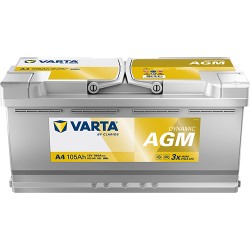
Based on the batteries we found for your vehicle, our experts help you pick the right one.
📋 What we found
For your Iveco Daily Vi Platform/Chassis 45C80E, 50C80E (2016) we found 3 compatible batteries. This list includes 1 Start-Stop battery and 2 conventional batteries (non Start-Stop).
📏 Battery size
The list contains batteries in different sizes or capacities (Ah). In many cases both variants fit, but it's worth checking your compartment dimensions and the Ah of your original battery before buying. If in doubt, choose the one with higher capacity: provided the size fits, it gives more headroom for cold starts and accessories.
⚡ Battery type for your vehicle
Does your Iveco Daily Vi Platform/Chassis 45C80E, 50C80E (2016) have a Start-Stop system? It shuts the engine off at short stops (traffic lights, jams) and restarts it automatically when you release the brake/clutch. If your dashboard has an "A-OFF" button or an engine icon with a circular arrow, it has it.
How do I know if my car has Start-Stop?
What happens if I fit a conventional battery in a Start-Stop car?
🔋 Technology (AGM / EFB)
✓ All Start-Stop batteries in the list are AGM — the most advanced technology. Perfect if your current battery was AGM or EFB: AGM always replaces both. Remember to register it via OBD if your car has a BMS (BMW, Audi, VAG, Mercedes…) so the alternator charges it correctly.
📊 View AGM vs EFB vs Conventional — full comparison
Here are the key differences between the three starter battery technologies. AGM is the most advanced technology (and the priciest); EFB is the middle ground for basic Start-Stop; conventional (also called flooded lead-acid) is the classic choice for non-Start-Stop cars.
| AGM | EFB | Conventional | |
|---|---|---|---|
| Charge cycles | Up to 3× more Start-Stop cycles than a conventional (cycle endurance certified to VDA standard) | ~2× more Start-Stop cycles than a conventional (cycle endurance certified to VDA standard) | Designed for start + alternator, not for repeated cycles |
| Expected life | 5-7 years under average use | 4-5 years under average use | 3-4 years under average use |
| Start-Stop compatible | ✓ Yes, even advanced systems (regenerative braking) | ✓ Yes, basic and mid-range Start-Stop | ✗ No — degrades within months |
| Cold start | Excellent (higher CCA) | Very good | Adequate |
| Relative price | €€€ (highest) | €€ (mid) | € (lowest) |
| Recommended for | Premium cars with advanced Start-Stop, many electrical accessories, heavy urban use | Mid-range Start-Stop cars, mixed city/motorway use | Non-Start-Stop cars, standard use, tight budget |
| Replacement rule | Replaces AGM and EFB; NEVER use EFB where AGM was original | Replaces EFB and conventional; does NOT replace AGM | Only conventional; not suitable for Start-Stop |
⭐ Our recommendation
For your Iveco Daily Vi Platform/Chassis 45C80E, 50C80E (2016) we recommend the VARTA A4 (AGM, 105 Ah). It also offers the highest capacity (Ah) and the highest cranking power (CCA) on the list — more headroom in cold starts and with many consumers. Varta is the world's leading manufacturer of starter batteries and supplies first-equipment (OEM) batteries to the major European car makers.
- Rated 4.8/5 by 41 verified customers.
Thanks for your feedback! We keep improving.
💬 Customer opinions are very important to us. We'd appreciate it if you could leave a short comment about what you liked.
With the currently active filters no battery from the list is shown. Remove a filter to see compatible options.
Verified selection
- Class: Car Batteries
- Brand: Iveco
- Model: Daily Vi Platform/Chassis
- Engine: 45C80E, 50C80E
- Year: 2016
Start Stop Battery
Battery for start-stop vehicles. Also a strong choice for more cycles, better charge recovery and longer service life.

| Categoría | Make | Referencia | Capacidad | Arranque en frío | Medidas | Tecnología | Price | |
|---|---|---|---|---|---|---|---|---|
| Start Stop Battery | VARTA | A4 | 105 Ah | 950 A | 393×175×190 mm | AGM | €172.14 | Más info |
Conventional Battery
This is a standard or conventional battery for vehicles without a start-stop system


Complete your purchase
Chargers
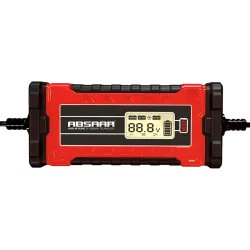
Chargers for your battery
Frequently asked questions
- The Iveco Daily Vi Platform/Chassis 45C80E, 50C80E 2016 may use different batteries depending on engine and equipment. We found 3 compatible batteries priced between 108,98€ — 172,14€. Check dimensions and positive terminal position before purchasing.
- To find the exact battery you need, you need to know the make, model, and engine. If your car has a Start-Stop system (the engine shuts off at traffic lights), you need an AGM or EFB battery. An AGM battery can only be replaced with another AGM battery. However, an EFB battery can be replaced with either another EFB or an AGM battery, as the latter is superior.
- The standard battery is the conventional type. The EFB battery withstands start/stop cycles better. The AGM battery is the most durable and is mandatory in cars with Start-Stop and regenerative braking. Never replace an AGM battery with an EFB or standard battery.
- Use the search tool by selecting your vehicle's make and model. Our system automatically filters compatible part numbers verified by our technicians. If you have any questions, contact us via WhatsApp.
- As they are consumable items, car batteries have a 2-year warranty, truck batteries a 1-year warranty, and all others (motorcycle batteries, cyclic batteries, etc.) a 6-month warranty. If a battery has a manufacturing defect, it will be replaced at no cost to the user.
- Under normal circumstances, batteries usually arrive within 1 to 2 days of ordering. However, there are some cases where delivery may take a little longer: peak seasons (Black Friday, Christmas, etc.), palletized shipments, occasional stock shortages, etc.
- In mainland Spain and Portugal delivery takes 24 working hours if you order before 17:00 and the battery is in stock; for the Balearic Islands, the Canary Islands and other EU destinations allow 2 to 5 days. Batteries are shipped fully charged and ready to install.
- ⚠ Then you need a battery designed for Start-Stop (EFB or AGM). We have hidden the conventional batteries from the list: fitting them in your car would ruin the battery within months and could damage the alternator. The batteries below are built for the frequent charge/discharge cycles of Start-Stop. 💡 Great. You can buy either a conventional or a Start-Stop (EFB or AGM) battery: a Start-Stop battery is perfectly valid in a non-Start-Stop car and is actually more robust (longer life, better cold-start performance). It is just a bit pricier. On vehicles older than year 2000, an EFB is preferable to an AGM: legacy alternators charge at a fixed voltage without temperature compensation, and an AGM needs a more precise charging profile to avoid losing life quickly — an EFB tolerates the classic alternator profile better. 💡 If in doubt, play it safe: buy a Start-Stop battery (EFB or AGM). It works in Start-Stop cars and non-Start-Stop cars alike, lasts longer and avoids any risk. You only pay a few euros more than a conventional one.
Guías
-
Generic guide to safely replace the battery of a Iveco Daily Vi Platform/Chassis 45C80E, 50C80E. Estimated time: 15-30 minutes. Typical tools: socket or open-end wrenches (usually 10-13 mm), sometimes Allen or Torx keys depending on the model. Depending on trim and equipment, this vehicle may use a conventional or a start-stop (AGM/EFB) battery. If it has a start-stop system, registering the battery via OBD is required after any replacement.
-
Prepare the vehicle Park on a flat surface, switch off the engine, remove the key (or disarm keyless systems) and make sure all lights and electrical accessories are off.
-
Locate the battery Open the hood and find the battery. It is usually in the engine bay, but on many modern cars it may be in the trunk, under the passenger seat or under a floor cover. Check the manual if you cannot find it.
-
Identify terminals and hold-down Find the positive terminal (marked «+», red cable, usually with a cover) and the negative (marked «−», black cable). Inspect how the battery is secured: the hold-down can be a lower clamp with a bolt, a threaded rod, a top bracket or a metal frame. Depending on the model you will need 10-13 mm sockets, open-end wrenches, Allen keys or Torx keys.
-
Disconnect the negative terminal first Using the right tool, loosen the negative terminal nut until you can lift the clamp off the post. Move the cable aside and secure it so it cannot touch the battery while you work. This order prevents short circuits.
-
Disconnect the positive terminal Remove the protective cover and loosen the positive clamp the same way. Move the cable aside, keeping it away from any metal part of the vehicle.
-
Remove the hold-down and lift the battery out Undo the bolts, clamps or rods securing the battery. Lift it straight up, keeping it vertical at all times. Batteries are heavy and contain acid: wear gloves and, if possible, use a proper carrying strap.
-
Install the new battery Clean the tray and terminals with a brush if you see corrosion. Place the new battery in the same orientation (positive and negative on the same side as the old one). Fit the hold-down and tighten firmly, without overtightening.
-
Connect terminals in the correct order Connect the positive terminal first and tighten the clamp. Then the negative. This order prevents sparks and shorts. Apply anti-corrosion grease on the posts if you have some. Replace the positive terminal cover.
-
Verify and, if required, register the battery Start the vehicle and check that everything works. On cars with a battery management system (BMS) it is strongly advised to register the new battery with an OBD scanner; otherwise the alternator may not charge it correctly. Re-initialise basic settings (clock, radio, windows) if the vehicle prompts you to.
General reference guide: always consult your vehicle manufacturer's manual before following these steps, as procedures may vary or not be suitable depending on model, year and equipment. If in doubt, consult a professional. baterias.com accepts no liability for damage resulting from an incorrect procedure.
-
-
Step-by-step guide to jump-starting the Iveco Daily Vi Platform/Chassis 45C80E, 50C80E using a donor car when the battery is flat. Estimated time: 10-15 minutes. Required: a set of insulated jumper cables with adequate gauge (at least 16 mm²) and a donor vehicle with a charged battery of the same or similar voltage. Depending on trim and equipment, this vehicle may use a conventional or a start-stop (AGM/EFB) battery. If it has a start-stop system, registering the battery via OBD is required after any replacement.
-
Prepare both cars Pull the donor car close to your Iveco Daily Vi Platform/Chassis 45C80E, 50C80E but make sure they don't touch. Switch both engines off, apply handbrakes, remove keys, and turn off lights, radio, HVAC and all electrical accessories. No one should be smoking nearby.
-
Inspect the flat battery If the battery has cracks, bulges, acid leaks or is frozen (after a hard freeze), DO NOT jump-start it — it could explode. Call a professional or replace it outright.
-
Connect the red (positive) clamp One end of the red clamp to the positive terminal (+) of the flat battery in the Iveco Daily Vi Platform/Chassis 45C80E, 50C80E. The other end to the positive (+) of the donor battery. Make sure the clamps don't touch any other metal part.
-
Connect the black (negative) clamp carefully One end to the negative terminal (−) of the donor battery. The OTHER end NOT to the Iveco Daily Vi Platform/Chassis 45C80E, 50C80E's negative: connect it to a bare metal part of the engine (a cylinder-head bolt, the alternator bracket, the engine block). This final step avoids sparks near the battery, which can release hydrogen and explode.
-
Start the donor then the Iveco Daily Vi Platform/Chassis 45C80E, 50C80E Start the donor car and let it idle for 2-3 minutes. Then try to start the Iveco Daily Vi Platform/Chassis 45C80E, 50C80E. If it doesn't fire, wait 10 seconds and retry. Never hold the starter for more than 5 seconds at a time — it overheats.
-
Disconnect in reverse order and charge With the Iveco Daily Vi Platform/Chassis 45C80E, 50C80E running, first remove the black clamp from the Iveco Daily Vi Platform/Chassis 45C80E, 50C80E's engine, then from the donor negative. Then the red clamp from the donor positive and finally from the Iveco Daily Vi Platform/Chassis 45C80E, 50C80E positive. Keep the Iveco Daily Vi Platform/Chassis 45C80E, 50C80E running for at least 15-20 minutes (ideally half an hour on the road) so the alternator can recharge the battery.
General reference guide: always consult your vehicle manufacturer's manual before following these steps, as procedures may vary or not be suitable depending on model, year and equipment. If in doubt, consult a professional. baterias.com accepts no liability for damage resulting from an incorrect procedure.
-
-
Six simple routines that extend the life of the Iveco Daily Vi Platform/Chassis 45C80E, 50C80E's battery from 3 to 5+ years. Doable in 15 minutes with a basic multimeter and a brush. Depending on trim and equipment, this vehicle may use a conventional or a start-stop (AGM/EFB) battery. If it has a start-stop system, registering the battery via OBD is required after any replacement.
-
Check the voltage every 6 months With a multimeter on DC voltage and the Iveco Daily Vi Platform/Chassis 45C80E, 50C80E at rest (engine off for at least 2 hours), the terminals should read 12.6-12.8 V. Below 12.4 V it is partially discharged and needs charging or replacement. Engine running, a healthy reading is 13.8-14.7 V (alternator charging).
-
Clean the terminals if sulphated If you see white-greenish powder on the terminals, first disconnect negative, then positive (always in that order). Brush the terminals with a wire brush and neutralise the acid with a mix of 1 tablespoon of baking soda in a glass of water. Dry well and apply anti-corrosion grease or petroleum jelly before reconnecting (positive first, negative second).
-
Verify the hold-down A loose battery vibrates with every bump and can lose up to half its service life. Check every 6 months that the clamp, rod or bracket is tight. Don't overtighten — plastic cases can crack — but keep it firm.
-
Avoid deep discharges A deep discharge (at rest below 12.0 V, or under load below 10.5 V) can cut battery life by up to 50%. Don't leave lights, radio, HVAC or USB chargers on with the engine off. If the Iveco Daily Vi Platform/Chassis 45C80E, 50C80E will sit unused for more than 2 weeks, connect an intelligent maintenance charger.
-
Verify the alternator A faulty alternator kills healthy batteries. With the engine running and the multimeter on the terminals, voltage should be 13.8-14.7 V. Above 14.8 V overcharges (boils the electrolyte); below 13.5 V undercharges. In either case, have the alternator diagnosed at a workshop.
-
Maintenance charger for long parking If the Iveco Daily Vi Platform/Chassis 45C80E, 50C80E sits parked for more than 2 weeks, connect an intelligent maintenance charger that supplies just enough current to compensate for parasitic drain (alarm, ECU, clock…). A smart 2-5 A charger costs 30-60 € / $40-80 and pays for itself by saving one battery.
General reference guide: always consult your vehicle manufacturer's manual before following these steps, as procedures may vary or not be suitable depending on model, year and equipment. If in doubt, consult a professional. baterias.com accepts no liability for damage resulting from an incorrect procedure.
-
-
Knowing your battery polarity (positive on the right or on the left) is the most important step before buying a replacement: connecting it the wrong way can damage the electronics. Estimated time: 2 minutes. Tools: eyes only — no tools required. Depending on trim and equipment, this vehicle may use a conventional or a start-stop (AGM/EFB) battery. If it has a start-stop system, registering the battery via OBD is required after any replacement.
-
Locate the battery Open the bonnet of the Iveco Daily Vi Platform/Chassis 45C80E, 50C80E and find the battery. It is usually a rectangular block with two metal terminals (large screw heads) on top — one red or "+" and one black or "−".
-
Identify the positive terminal The positive terminal (+) typically has a red cap, red sticker or cover, a raised "+" symbol on the casing, and/or a slightly larger diameter (19 mm vs 17 mm of the negative, in standard European batteries).
-
Face the battery Look at the battery from the label side with the terminals near you — the edge with the terminals should face you, not the back.
-
Determine polarity If the positive pole is on the RIGHT → choose a battery marked as "positive right". If it is on the LEFT → choose one marked as "positive left". (If the label of your current or new battery shows codes like 0, 1, 3 or 4: 0 and 4 are positive right; 1 and 3, positive left — 3 and 4 correspond to batteries with terminals on the narrow side.)
-
Note the reference The label on top shows the reference (e.g. "A9", "TK960", "EA900"). Search for the exact model with that reference and the identified polarity — never change polarity without consulting the vehicle manufacturer.
General reference guide: always consult your vehicle manufacturer's manual before following these steps, as procedures may vary or not be suitable depending on model, year and equipment. If in doubt, consult a professional. baterias.com accepts no liability for damage resulting from an incorrect procedure.
-