

Batteries for Suzuki 250 LT 4WD Quad Runner
Which battery does a Suzuki 250 LT 4WD Quad Runner need?
Specifications and battery: LT 4WD Quad Runner
Suzuki 250 LT 4WD Quad Runner: depending on the equipment, it takes a conventional 30 Ah, 300 A battery (165 × 132 × 176 mm) or a conventional 14 Ah, 190 A battery (136 × 91 × 166 mm). Measure your current battery before choosing.
Battery for this engine
| Version | Technology | Capacity | Cold cranking (EN) | Size (L×W×H) | Polarity |
|---|---|---|---|---|---|
| Depending on equipment 1 | Conventional | 30 Ah | 300 A | 165 × 132 × 176 mm | + on the right |
| Depending on equipment 2 | Conventional | 14 Ah | 190 A | 136 × 91 × 166 mm | + on the left |
Data: vehicle specifications and the battery manufacturer's application catalogue.
Battery analysis for your Suzuki 250 LT 4WD Quad Runner
Quick answer Depending on the equipment, your vehicle uses one of these two main batteries: ordinary lead-acid 30 Ah (165×132×176 mm), for which we recommend VARTA YB30L-B, or ordinary lead-acid 14 Ah (136×91×166 mm): VARTA YB14-A2. Before buying, check the Ah on your current battery's label or measure its length.
Batteries in your Suzuki 250 LT 4WD Quad Runner
Measure the width of yours: 132 or 91 mm
Prices and availability updated on 24/10/2026
Based on the batteries we found for your vehicle, our experts help you pick the right one.
📋 What we found
For your Suzuki 250 LT 4WD Quad Runner we found 7 compatible batteries. This list includes 2 AGM or EFB batteries and 5 conventional batteries.
📏 Battery size
The list contains batteries in different sizes or capacities (Ah). In many cases both variants fit, but it's worth checking your compartment dimensions and the Ah of your original battery before buying. Choose the one with the same dimensions as your current battery: a bigger one may not fit the compartment or the hold-down. If several match your size, the higher capacity gives more headroom for cold starts.
📊 View AGM vs EFB vs Conventional — full comparison
⭐ Our recommendation
For your Suzuki 250 LT 4WD Quad Runner we recommend the VARTA YB30L-B (ordinary lead-acid, 30 Ah). Varta is the world's leading manufacturer of starter batteries and supplies first-equipment (OEM) batteries to the major European car makers.
- Get it on Tuesday before 5 PM — your product ships on Monday.
Thanks for your feedback! We keep improving.
💬 Customer opinions are very important to us. We'd appreciate it if you could leave a short comment about what you liked.
With the currently active filters no battery from the list is shown. Remove a filter to see compatible options.
Verified selection
- Class: Quads Batteries
- Brand: Suzuki
- Model: 250
- Engine: LT 4WD Quad Runner
AGM / EFB batteries
AGM or EFB technology batteries: more charge cycles, faster recovery and a longer life than a conventional battery.


Conventional batteries
Standard lead-acid batteries.
-

Motorcycle battery Varta YB30L-B (530400030) 12V 30Ah 300A
- 12 V
- 30 Ah
- 300 A
Dimensions 165×132×176 mm
- ✓ Varta brand
€176.30
-
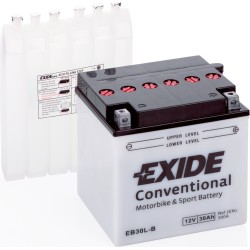
Motorcycle battery Exide EB30L-B 12V 30Ah 300A
- 12 V
- 30 Ah
- 300 A
- Conventional EXIDE EB30L-B · 30 Ah · 300 A
Dimensions 165×130×175 mm
€88.80
-

Motorcycle battery Varta YB14-B2 (514014014) 12V 14Ah 190A
- 12 V
- 14 Ah
- 190 A
Dimensions 134×89×166 mm
€133.10
-

Motorcycle battery Varta YB14-A2 (514012014) 12V 14Ah 190A
- 12 V
- 14 Ah
- 190 A
Dimensions 136×91×166 mm
€128.20
-

Motorcycle battery Fulbat FHD32HL-BS GEL 12V 33.6Ah 445A GEL
- 12 V
- 33.60 Ah
- 445 A
- GEL FULBAT FHD32HL-BS GEL · 33.60 Ah · 445 A
Dimensions 165×130×175 mm
€214.35


| Category | Make | Reference | Capacity | Cold cranking | Dimensions | Technology | Price | |
|---|---|---|---|---|---|---|---|---|
| Conventional batteries | VARTA | 530400030 | 30 Ah | 300 A | 165×132×176 mm | Conventional | €176.30 | More info |
| Conventional batteries | EXIDE | EB30L-B | 30 Ah | 300 A | 165×130×175 mm | Conventional | €88.80 | More info |
| Conventional batteries | VARTA | 514014019 | 14 Ah | 190 A | 134×89×166 mm | Conventional | €133.10 | More info |
| Conventional batteries | VARTA | 514012019 | 14 Ah | 190 A | 136×91×166 mm | Conventional | €128.20 | More info |
| Conventional batteries | FULBAT | FHD32HL-BS GEL | 33.60 Ah | 445 A | 165×130×175 mm | GEL | €214.35 | More info |
Frequently asked questions
- Suzuki 250 LT 4WD Quad Runner: depending on the equipment, it takes a conventional 30 Ah, 300 A battery (165 × 132 × 176 mm) or a conventional 14 Ah, 190 A battery (136 × 91 × 166 mm). Measure your current battery before choosing. We found 7 compatible batteries priced between 88,80€ — 214,35€. Check dimensions and positive terminal position before purchasing.
- Yes, you can install a higher capacity (Ah) battery as long as the physical dimensions fit your Suzuki 250 LT 4WD Quad Runner battery compartment and the positive terminal position matches.
- Use the search tool by selecting your vehicle's make and model. Our system automatically filters compatible part numbers verified by our technicians. If you have any questions, contact us via WhatsApp.
- All our batteries come with the legal guarantee provided by consumer law against manufacturing defects. If a battery has a manufacturing defect, it will be replaced at no cost to the user.
- Under normal circumstances, batteries usually arrive within 1 to 2 days of ordering. However, there are some cases where delivery may take a little longer: peak seasons (Black Friday, Christmas, etc.), palletized shipments, occasional stock shortages, etc.
- Motorcycles can use GEL, AGM or conventional batteries. GEL is ideal for occasional use as it holds its charge well. AGM is the best choice for intensive use or high-powered bikes. Always verify the polarity before installing.
- Polarity indicates which side the positive terminal (+) is on. For motorcycles this is critical as some models have the positive on the left and others on the right. Check the label on your current battery or the owner's manual.
- Yes. First disconnect the negative cable (−), then the positive (+). When fitting the new battery, connect the positive (+) first, then the negative (−). Always respect the correct polarity.