

Batteries for Suzuki GSX GSX 250 E 17 hp (petrol, 1980-1983)
Which battery does a Suzuki GSX GSX 250 E need?
Suzuki GSX GSX 250 E (17 hp, petrol, 1980-1983) takes a conventional 11 Ah, 150 A battery (136 × 91 × 146 mm), with the positive terminal on the right.
Compatible with your Suzuki GSX GSX 250 E
Recommended
Motorcycle battery Varta 12N10-3B Powersports (511013009) 12V 11Ah 150A
11 Ah · 150 A · Conventional
136×91×146 mm · + terminal on the right
Get it on Tuesday with express delivery (Spain mainland and Portugal only).
VAT includedOfficial warrantyFree returns within 14 daysHome fitting from €96.80 per battery
Specifications and battery: GSX 250 E (17 hp)
Battery for this engine
| Version | Technology | Capacity | Cold cranking (EN) | Size (L×W×H) | Polarity |
|---|---|---|---|---|---|
| Main | Conventional | 11 Ah | 150 A | 136 × 91 × 146 mm | + on the right |
How do I know if my battery's positive terminal is on the right or the left? +Positive on the right
The position of the positive terminal only counts when you look at the battery from the side where the terminals are. From behind, the + seems to be on the other side. To check yours:
- Open the bonnet and stand in front of the battery, with both terminals on the side nearest to you.
- Find the + terminal: it usually has a red cap or the red cable.
- If it is on your right, you need a battery with the + on the right; if it is on your left, one with the + on the left.
All these batteries have the positive on the right
All four pictures show the same battery, and every battery compatible with your vehicle has the + on the right. But to check it, you have to look from where the eye is, i.e. facing the terminals. So you may see the + on the left while your battery actually has the positive on the right: it just means you are not looking at it from the right side.
- Brand
-
- Model
- GSX
- Built
- 1980 - 1983
- Fuel
- Petrol
- Cylinders
- 2
- Drive
- Chain
This engine shares its battery with the GSX 250 E (27 hp), GSX 250 E Black Hawk (17 hp), GSX 400 E (27 hp), GSX 400 E (41 hp) and 4 more: the compatible batteries are exactly the same.
Data: vehicle specifications and the battery manufacturer's application catalogue.
EFB, AGM or conventional for this engine?
Rule of thumb for the Suzuki GSX GSX 250 E: fit the same technology as the original or better (conventional → EFB → AGM), with equal or higher capacity and cold cranking amps, and respect the size and terminal position of around 11 Ah.
Quick answer You need an ordinary lead-acid battery of 11 Ah. Our recommendation: VARTA 12N10-3B.
See the expert's analysisWhat to check before buying and why we recommend this one
How to choose the battery for your Suzuki GSX GSX 250 E
1. Check this before you buy
Measure the length of yours. The original one usually measures 136 × 91 × 146 mm.
Positive on the right, looking at it from the front with the terminals towards you. How to check
2. Your options
Varta 12N10-3B · Conventional 11 Ah 150 A
It has the technology, size and polarity your Suzuki GSX GSX 250 E normally takes: the balanced choice.
See in the list3. Why we recommend the Varta 12N10-3B
- It should fit your battery tray: 136 mm long and + on the right. Check it against yours.
- Get it on Tuesday with express delivery (Spain mainland and Portugal only).
Yours does not match?
If your current battery has different Ah, a different size or the positive on the other side, choose by what its label says.
AGM or conventional: differences
AGM
- Charge cycles
- Up to 3× more Start-Stop cycles than a conventional (cycle endurance certified to VDA standard)
- Expected life
- 5-7 years under average use
- Cold start
- Excellent (higher CCA)
- Recommended for
- Premium cars with advanced Start-Stop, many electrical accessories, heavy urban use
- Replacement rule
- Replaces AGM, EFB and conventional; NEVER use EFB where AGM was original
Conventional
- Charge cycles
- Designed for start + alternator, not for repeated cycles
- Expected life
- 3-4 years under average use
- Cold start
- Adequate
- Recommended for
- Non-Start-Stop cars, standard use, tight budget
- Replacement rule
- Only conventional; not suitable for Start-Stop
Rule of thumb: you can normally move up in technology (conventional → EFB → AGM), but not down.
Reviewed by the baterias.com technical team · Prices as of 28/11/2026
With the currently active filters no battery from the list is shown. Remove a filter to see compatible options.
Thanks for your feedback! We keep improving.
💬 Customer opinions are very important to us. We'd appreciate it if you could leave a short comment about what you liked.
Conventional batteries
Standard lead-acid batteries.
-

Motorcycle battery Varta 12N10-3B Powersports (511013009) 12V 11Ah 150A
- 12 V
- 11 Ah
- 150 A
- Conventional VARTA 511013015 · 11 Ah · 150 A
Dimensions 136×91×146 mm + right
- Varta brand
€40.70
-

Motorcycle battery Varta 12N10-3A Powersports (511012009) 12V 11Ah 150A
- 12 V
- 11 Ah
- 150 A
Dimensions 136×91×146 mm + right
€121.50
-
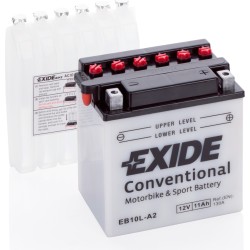
Motorcycle battery Exide EB10L-A2 YB10L-A2 12V 11Ah 130A
- 12 V
- 11 Ah
- 130 A
- Conventional EXIDE EB10L-A2 · 11 Ah · 130 A
Dimensions 135×90×145 mm + right
€54.40
-

Motorcycle battery Fulbat FB10L-A2/B2 GEL 12V 11.6Ah 120A GEL
- 12 V
- 11.60 Ah
- 120 A
- GEL FULBAT FB10L-A2/B2 GEL · 11.60 Ah · 120 A
Dimensions 133×90×145 mm + right
€73.63
Compare the 4 batteries in a table
| Photo | Brand and part number | ETN | Technology | Ah | Cold cranking (EN) | Size (mm) | Polarity | Hold-down | Price | Quantity |
|---|---|---|---|---|---|---|---|---|---|---|
 | VARTA 511013015 Recommended 11 Ah · 150 A · 136×91×146 · + right Conventional · ETN 511013015 | 511013015 | Conventional | 11 Ah | 150 A | 136×91×146 | + right | — | €40.70 Excl. VAT €33.64 |
|
 | VARTA 511012015 11 Ah · 150 A · 136×91×146 · + right Conventional · ETN 511012015 | 511012015 | Conventional | 11 Ah | 150 A | 136×91×146 | + right | — | €121.50 Excl. VAT €100.41 |
|
 | EXIDE EB10L-A2 11 Ah · 130 A · 135×90×145 · + right Conventional · Hold-down B0 | — | Conventional | 11 Ah | 130 A | 135×90×145 | + right | B0 | €54.40 Excl. VAT €44.96 |
|
 | FULBAT FB10L-A2/B2 GEL 11.60 Ah · 120 A · 133×90×145 · + right GEL | — | GEL | 11.60 Ah | 120 A | 133×90×145 | + right | — | €73.63 Excl. VAT €60.85 |
|
Verified selection
- Class: Motorcycle Batteries
- Brand: Suzuki
- Model: GSX
- Engine: GSX 250 E
Frequently asked questions
- Suzuki GSX GSX 250 E (17 hp, petrol, 1980-1983) takes a conventional 11 Ah, 150 A battery (136 × 91 × 146 mm), with the positive terminal on the right. We found 4 compatible batteries priced between 40,70€ — 121,50€. Check dimensions and positive terminal position before purchasing.
- Yes, you can install a higher capacity (Ah) battery as long as the physical dimensions fit your Suzuki GSX GSX 250 E battery compartment and the positive terminal position matches.
- Motorcycles can use GEL, AGM, or conventional batteries. GEL batteries are ideal for occasional use. AGM batteries are the best option for heavy use or high-power motorcycles. Always check the polarity before installation.
- Polarity indicates which side has the positive (+) terminal. This is critical for motorcycles because some models have the positive terminal on the left and others on the right. Check the label on your current battery or the manufacturer's manual.
- Yes. First disconnect the negative (−) wire and then the positive (+) wire. When installing the new one, connect the positive (+) wire first and then the negative (−) wire. Always respect the correct polarity.
- Use the search tool by selecting your vehicle's make and model. Our system automatically filters compatible part numbers verified by our technicians. If you have any questions, contact us via WhatsApp.
- All our batteries come with the legal guarantee provided by consumer law against manufacturing defects. If a battery has a manufacturing defect, it will be replaced at no cost to the user.
- Under normal circumstances, batteries usually arrive within 1 to 2 days of ordering. However, there are some cases where delivery may take a little longer: peak seasons (Black Friday, Christmas, etc.), palletized shipments, occasional stock shortages, etc.