
Car battery voltage: what your reading means
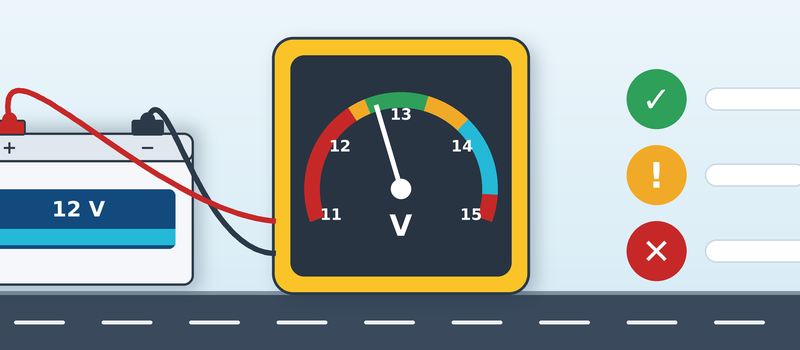
Short answer: with the engine off and the car left to rest for at least 2 hours, a charged 12 V battery reads 12.6–12.8 V (an AGM, slightly more). At 12.4–12.5 V it's partly charged; below 12.4 V it needs charging, and at around 12.0 V it's flat. With the engine running, the alternator should deliver about 13.8–14.7 V (smart alternators can go lower without a fault). And if the voltage drops below 9.6–10 V while cranking, the battery is weak. Enter your reading in the tool below and we'll tell you what it means and what to do.
⚡ The essentials in 20 seconds
- To know the real state of charge, measure at rest: car off for 2 hours or more. Straight after a drive, the reading comes out too high.
- 12.6–12.8 V charged · 12.4–12.5 V keep an eye on it · below 12.4 V charge it · around 12.0 V flat.
- Engine running: 13.8–14.7 V = the alternator is charging; over 15 V = faulty regulator.
- When cranking, a drop below 9.6–10 V points to a weak battery (if it was charged).
- Voltage shows charge, not health: an old battery can read 12.6 V and still lack power. Average life is 4–5 years.
Check what your reading means
Enter the voltage shown on your multimeter, when you measured it and what type of battery it is. Everything is worked out in your browser: no data is sent anywhere.
Car battery voltage chart (12 V)
A reading only makes sense if you know when you took it: at rest, with the engine running or while cranking. These are the reference values for a 12 V lead-acid car battery (conventional, EFB or AGM):
| When you measure | Reading | What it means | What to do |
|---|---|---|---|
| At rest (2 h or more) | 12.6–12.8 V | Charged (a full AGM reads slightly higher) | Nothing. If it starts poorly, check its age or use a battery tester |
| At rest | 12.4–12.5 V | Partly charged | Top it up with a charger and keep an eye on it |
| At rest | 12.0–12.3 V | Discharged | Charge it as soon as possible and find the cause |
| At rest | Below 12.0 V | Deeply discharged; below about 11 V, possibly a dead cell | Slow charge with a smart charger; if it doesn't recover, replace it |
| Engine running (idle) | 13.8–14.7 V | The alternator is charging properly | Nothing |
| Engine running | 13.3–13.7 V | Slightly low | Normal with smart alternators when the battery is full; otherwise, get it checked |
| Engine running | Below 13.3 V | Not charging enough (with smart charging, 12.5–13 V can be normal at times) | Check the belt, terminals and alternator |
| Engine running | Over 15 V | Overcharging | Garage: usually the regulator; it ruins the battery |
| While cranking (lowest value) | 10 V or more | The battery has enough power | Nothing |
| While cranking | 9.6–10 V | Borderline | Charge it and repeat the test |
| While cranking | Below 9.6 V | Weak battery | If it was charged, consider replacing it |
Why 12.6 V and not 12? A car battery has 6 cells of about 2.1 V each: 6 × 2.1 ≈ 12.6 V when full. That's why differences of just a few tenths separate a charged battery from a half-empty one. More detail in our glossary: what battery voltage means.
How to test a car battery with a multimeter
All you need is a basic multimeter and five minutes. For a complete diagnosis, take all three readings: at rest, while cranking and with the engine running.
- Set up the multimeter. Select DC volts (the V with a straight line, sometimes marked ‘DCV’) on the 20 V range.
- Let the car rest. Off, locked and with everything switched off for at least 2 hours; overnight is better.
- Measure at the terminals. Red probe on the positive (+), black on the negative (−), on bare terminal metal rather than a corroded nut. That's your resting reading.
- Measure while cranking. With someone else starting the car, watch for the lowest value while the starter motor turns. Many multimeters have a MIN function to hold it.
- Measure with the engine running. At idle, on the same terminals. Then switch on the lights, heated rear window and blower and see whether the voltage holds.
With the engine running, keep clear of the belt and the fan. Never bridge the two terminals with a metal tool. If the battery is swollen, leaking or smells of rotten eggs, don't charge it: replace it. If it sits in the boot or under a seat, many cars have measuring points under the bonnet: use the ones shown in the manufacturer's handbook.
A battery tester goes a step further than a multimeter: as well as the voltage, it estimates the cranking power (CCA), which is what really fades as a battery ages.
Why the battery reads higher just after switching off
While you drive, the alternator leaves the battery with a surface charge: for a while it reads higher than its true charge. The same happens straight after charging with a charger, when it can stay above 13 V for hours. That's why the reliable reading is the one at rest, after 2 hours or more.
If you measure just after switching off and it's already below 12.4 V, that's a bad sign: either the alternator isn't charging it or the battery can't hold charge. Check what it reads with the engine running.
AGM and EFB battery voltage: is it any different?
The scale is practically the same. A full AGM usually reads slightly higher than a conventional battery, so an AGM sitting right on 12.6 V may not be at 100%. An EFB reads like a conventional one. In all three cases, below 12.4 V it needs charging.
- Charge AGM batteries with a charger that has an AGM mode: it limits the charging voltage.
- If your car has Start-Stop and it stops cutting the engine at traffic lights, that's often the first sign that the battery is low.
- When replacing it, choose the same technology or better (conventional → EFB → AGM), never worse: a Start-Stop car needs EFB or AGM. We explain it in EFB, AGM or conventional: which battery your car needs.
Smart alternators: when 12.5–13 V with the engine running is normal
On many recent cars, especially those with Start-Stop or regenerative braking, the engine control unit decides how much the alternator charges. With a full battery it can drop the voltage to 12.5–13 V to save fuel and raise it when you brake. So a low reading with the engine running isn't always a fault.
To find out, switch on some loads (lights, heated rear window, blower) and watch: if the voltage holds or rises, the system is responding. If it stays low and the battery goes flat day after day, the alternator needs checking. Full diagnosis in is it the battery or the alternator?
What to do based on your result
- If it's low (below 12.4 V): charge it with a smart battery charger, let it rest for a few hours and measure again.
- If it goes flat again within a few days: something is drawing current while the car is parked or the alternator isn't charging. Follow the steps in flat car battery: what to do.
- If the car won't start now: you can jump-start it with leads or a jump starter, always following the manufacturer's handbook.
- If the car will be parked for weeks: leave it on a battery maintainer so it doesn't sulphate.
- If it's time to replace it (it doesn't recover after charging, drops below 9.6 V when cranking while charged, or it's over 4–5 years old and failing): choose the same technology or better and follow the car manufacturer's specifications. More in how long a car battery lasts and how to replace a car battery.
Voltage measures charge, not health. An old or sulphated battery can read 12.6 V at rest and collapse as soon as you crank. That's why the cranking test (or a battery tester) is what confirms whether the battery needs replacing.
Car battery voltage: frequently asked questions
What is the normal voltage of a car battery?
With the engine off and after 2 hours or more at rest, a charged 12 V battery reads 12.6–12.8 V (an AGM, slightly more). With the engine running, the alternator normally keeps it at around 13.8–14.7 V.
At what voltage is a car battery flat?
Below 12.4 V at rest it needs charging, and at around 12.0 V it's flat. If it reads below about 11 V at rest, the discharge is very deep or a cell is damaged; if it won't go above 12.4 V after a full charge, it needs replacing.
What should a car battery read with the engine running?
About 13.8 to 14.7 V: that shows the alternator is charging. Below 13.3 V it's charging too little, except on cars with a smart alternator, which may deliberately drop to 12.5–13 V when the battery is full. Over 15 V usually means a faulty regulator.
How much should battery voltage drop when cranking?
It's normal for it to drop while the starter motor turns, but a healthy, charged battery shouldn't fall below about 10 V. Between 9.6 and 10 V it's borderline, and below 9.6 V the battery is weak. The drop is bigger in cold weather.
Can a battery reading 12.6 V still be bad?
Yes. Voltage shows charge, not capacity: an old or sulphated battery can read 12.6 V at rest and still lack the power to start the car. To confirm, measure the voltage while cranking or use a battery tester.
Why does my battery read over 13 V with the engine off?
Because of the surface charge left by the alternator or a charger. For a while the battery reads higher than its real charge. Wait at least 2 hours with everything off and measure again to see its true state.
Is 12.2 V too low for a car battery?
Yes: 12.2 V at rest means the battery is discharged. Charge it with a charger as soon as possible, because left like that it sulphates. If it goes flat again within a few days, check whether something is drawing current while parked or whether the alternator is charging properly.
How often should I check my battery voltage?
Before winter and before summer is usually enough, plus whenever the car starts less eagerly. If the car sits for weeks, check it once a month or leave it on a battery maintainer.
Time for a new battery?
Search by make and model to see only the batteries that fit your car, with the same technology or better. Number plate search works with Spanish, Portuguese and Italian plates.
Find my battery →