
Hybrid car battery: the 12 V one or the big one? Which fails and what it costs
RSS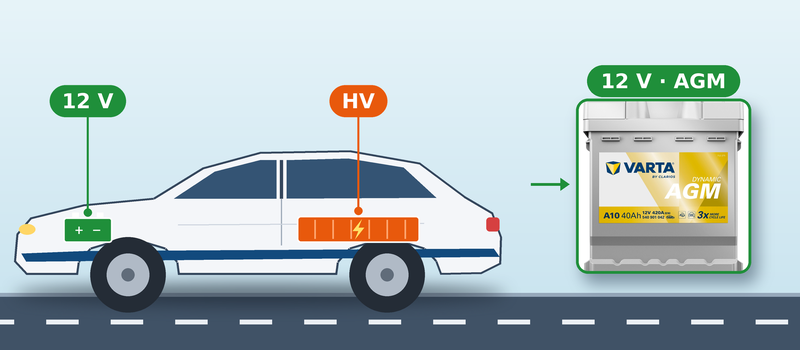
Short answer: every hybrid car has two batteries. The big high-voltage pack drives the electric motor and costs thousands of euros, but rarely fails. The one that leaves you stranded is the small 12 V battery, which powers up the electronics and costs roughly €45–215. If your hybrid won't light up the dashboard or never shows "READY", start there: find it by registration in our battery finder.
⚡ The essentials in 20 seconds
- Nothing lights up or no "READY" → almost certainly the 12 V battery.
- It powers up but warns "check hybrid system" → main dealer (high voltage).
- The 12 V battery only charges while the car is in READY: days parked drain it.
- If it sits in the boot or under the seat, it must be AGM.
The two batteries in a hybrid
People searching for a "hybrid battery price" usually mean the traction pack. But the car has another one, a 12 V battery like any petrol car's, and that is the one that actually gets replaced every few years.
| High-voltage battery | 12 V battery | |
|---|---|---|
| What it does | Drives the electric motor and starts the petrol engine | Wakes the ECU, locks and lights, and connects the big battery |
| Voltage | Hundreds of volts (48 V in mild hybrids) | 12 V |
| When it fails | Rarely; often lasts as long as the car | Every 4–5 years on average, sooner if the car sits for days |
| Rough price | About €2,000–3,500 on a small hybrid, at a dealer | €45–215 depending on model and technology |
| Who replaces it | Only a garage trained in high voltage | You, following the handbook, or any garage |
| Do we sell it? | No | Yes |
My hybrid won't start: which battery is it?
In a full or plug-in hybrid the 12 V battery does not crank the engine: the electric motor does that using the big battery. But without 12 V the ECU never wakes up and the big battery is never connected, so nothing happens. That is why a flat 12 V battery is so often mistaken for a "hybrid system" fault.
- The remote won't unlock or the dashboard stays dark, or it dies when you press start: it's the 12 V battery.
- The dashboard lights up but "READY" never appears, warning lights flicker or random messages pop up: almost always a weak 12 V battery. With a multimeter, measure at rest: below 12.4 V it is low; below 12.0 V, flat.
- It reaches READY but warns "check hybrid system", or the petrol engine never switches off: that points to the high-voltage side. Don't touch it: main dealer.
Never touch the orange cables. They carry high voltage. Everything here refers only to the 12 V battery and its two terminals.
Why a hybrid's 12 V battery goes flat more in winter
In a normal car the alternator recharges the battery whenever the engine runs. A hybrid has no alternator: a converter charges it from the big battery, and only while the car is in READY. Leave it parked for a week or two and the smart key, alarm and connected modules slowly drain a battery that is small to begin with (35–60 Ah). Cold weather cuts capacity and finishes the job — the same cause we explain in why cars won't start in winter, only stronger.
If it will sit for a while: put it in READY for half an hour once a week (outdoors, in P) or connect a maintenance charger to the 12 V battery.
Already flat? Many hybrids have a jump-start terminal in the engine-bay fuse box even when the battery is in the boot; the handbook shows where. Follow how to jump-start a car safely, and note that many manufacturers advise against using a hybrid to jump another car.
Which 12 V battery does a hybrid take?
It depends mainly on where it sits:
- In the engine bay: usual in modern hybrids. It can be conventional, EFB or AGM; use the same technology as the original or a higher one.
- In the boot or under the rear seat (as in some older-generation hybrids): it must be AGM, sealed and with a vent-tube outlet. A conventional battery inside the cabin should not be an option.
- 48 V mild hybrids and plug-ins: they use a Start-Stop 12 V battery (EFB or AGM). The rules in EFB, AGM or conventional apply.
This table lists the hybrids we are asked for most and the battery shown on each car's page. It is a guide only: version and year change the battery, so confirm it by registration and against your car manufacturer's specifications (owner's handbook or main dealer).
| Model | Original 12 V battery | Capacity / cranking | Positive | Shop option |
|---|---|---|---|---|
| Toyota Yaris 1.5 Hybrid (2020–) | Conventional | 44 Ah / 420 A | Right | Varta A10 (AGM upgrade) · Varta B36 |
| Toyota Yaris Cross 1.5 Hybrid | Conventional | 44 Ah / 420 A | Right | Varta A10 (AGM upgrade) · Varta B36 |
| Toyota C-HR 1.8 Hybrid | Conventional or AGM (by trim) | 54 Ah / 530 A · 50 Ah / 540 A | Right | Varta C30 · Varta A9 |
| Toyota Auris 1.8 Hybrid | AGM | 45 Ah / 380 A | Right | Exide EK454 |
| Toyota Prius+ 1.8 Hybrid | AGM | 45 Ah / 380 A | Left | Tudor TK457 |
| Toyota Prius 1.8 Hybrid (3.ª gen.) | AGM | 45 Ah / 380 A | Left | Tudor TK457 |
| Lexus CT 200h | AGM | 45 Ah / 380 A | Left | Tudor TK457 |
| Toyota RAV4 IV 2.5 Hybrid | AGM | 45 Ah / 380 A | Left | Tudor TK457 |
| Toyota RAV4 V 2.5 Hybrid | Conventional | 52 Ah / 470 A | Right | Varta C22 |
| Kia Niro 1.6 GDI Hybrid | Conventional | 52 Ah / 470 A | Right | Varta C22 |
| Hyundai Tucson 1.6 T-GDI 48V | Conventional | 60 Ah / 540 A | Left | Varta D43 |
| Renault Arkana E-Tech 145 | AGM | 60 Ah / 680 A | Right | Varta A8 |
| Ford Kuga 2.5 Plug-in Hybrid | EFB | 50 Ah / 550 A | Right | Varta N50 |
Which 12 V battery does your hybrid take?
Enter your registration and we'll show only the batteries that fit, with the original technology.
Search by registration →Hybrid-specific references: A9, A10, A11, A12, TK454, TK457, FT438-U1R
Besides ordinary car batteries, hybrids and some EVs use formats rarely seen elsewhere: narrow boot-mounted boxes, thin Japanese-style terminals or compact batteries. These are the ones we're asked about most, with the data from their product pages. The last column lists the cars for which our finder suggests each one, based on the application catalogue; the one your car takes is confirmed by the registration finder. Your car manufacturer's specifications always take precedence over this table.
| Reference | Technology | Ah / cranking | Size (mm) | Positive | Terminals | Cars (per our finder) and notes |
|---|---|---|---|---|---|---|
| Varta A9 | AGM | 50 Ah / 540 A | 207 × 175 × 190 | Right | Not stated on the page | Standard 207 mm box. The finder lists it for, among others, Toyota C-HR, Corolla (E21) and RAV4 V, Fiat 500 and Panda, Kia Niro, Ford Kuga III, Nissan Leaf (ZE1), Renault Zoe and Mégane E-Tech, VW ID.3/ID.4 and several BMWs (5 Series G30, X3 G01, X5 G05…). |
| Varta A10 | AGM | 40 Ah / 420 A | 175 × 175 × 190 | Right | Not stated on the page | 175 mm box. The finder lists it for the Ford Mustang Mach-E and Lamborghini Aventador. It is also the AGM upgrade for conventional 175 mm batteries such as the B36 in the Toyota Yaris and Yaris Cross hybrids, despite slightly less capacity (40 vs 44 Ah). |
| Varta A11 | AGM | 45 Ah / 370 A | 236 × 126 × 224 | Left | Type 3 (per product page) | Narrow box. Depending on version, the finder may offer it for the Prius (3rd gen.), Prius+, Prius C, Auris (E18), RAV4 IV hybrid and Lexus CT 200h. 370 A cranking: compare it with your current battery. |
| Varta A12 | AGM | 35 Ah / 340 A | 196 × 126 × 223 | Left | Type 3 (per product page) | Narrow 35 Ah box. The finder does not link it to specific models today: only if your current battery has this size and capacity. |
| Tudor TK454 · Exide EK454 | AGM | 45 Ah / 380 A | 237 × 127 × 227 | Right | TK454: EN taper post · EK454: not stated | Same box as the TK457 with the positive on the right. The finder lists it for the Toyota Auris (E15, E18), 1st-gen. Prius, Mitsubishi Outlander III and some versions of the Tesla Model 3 and Nissan Leaf (ZE0). |
| Tudor TK457 · Exide EK457 | AGM | 45 Ah / 380 A | 237 × 127 × 227 | Left | TK457: JIS taper post · EK457: not stated | Same box as the TK454 with the positive on the left. The finder recommends it for the Prius (3rd gen.), Prius+, RAV4 IV hybrid and Lexus CT 200h; it also appears for the Prius C and Auris (E18) depending on version. |
| Fullriver FT438-U1R | AGM | 35 Ah / 438 A | 196 × 131 × 192 | See page | M6 + TP26 (SAE) | Compact U1R box sold as an auxiliary battery for Tesla. The finder does not link it to specific models today: compare size and terminals with yours before ordering. |
Before ordering one of these, compare four things with the one you have:
- Positive side. The TK454 and TK457 share the same box with reversed polarity: get it wrong and the cables won't reach.
- Terminal type. Some Japanese cars use thinner (JIS) terminals; a European clamp won't grip them properly and vice versa.
- Capacity and cranking equal to or higher than the original, with the same technology or higher. When you move up a technology (conventional or EFB to AGM), slightly less capacity is acceptable: e.g. Varta E11 (74 Ah) → A7 AGM (70 Ah).
- Vent tube. If it sits in the boot or cabin, the new one must be AGM with its vent tube connected.
Above all, your car manufacturer's specifications come first: if the handbook says otherwise, follow the handbook. Not sure? Send us a photo of your battery label before buying and we'll confirm.
Lithium batteries. Some recent EVs and hybrids no longer use a lead-acid 12 V battery but a lithium one. If your label says Li-ion or LiFePO4, don't replace it with a lead-acid battery without first checking with the car manufacturer.
What about the "auxiliary battery" in Mercedes, Volvo or BMW?
That's something else. Many cars, hybrid or not, carry a second small 12 V battery (9–15 Ah) that backs up Start-Stop and the electronics while the main one cranks. When it fails, the dashboard shows an "auxiliary battery malfunction" type message. The most requested is the Varta AUX14; the rest are in auxiliary batteries.
Replacing a hybrid's 12 V battery, step by step
Before any replacement, check your car manufacturer's procedure (owner's handbook or main dealer). Each brand may have its own steps: disconnection order, where to connect a charger or jump leads, how to reset systems or whether the new battery must be registered. What follows is general guidance and does not replace those instructions.
- Switch the car off completely and move the smart key away so it doesn't wake up.
- Locate the battery (engine bay, boot or under the seat) and note which side the positive is on.
- Disconnect the negative first, then the positive. On a boot-mounted AGM, release the vent tube.
- Fit the new one as specified by your car manufacturer: same or higher technology and same size. Connect positive first, then negative; refit the vent tube.
- Start up to READY and leave it a few minutes. You may need to reset windows or the clock. Some models, mostly German, require the new battery to be registered in the ECU.
If you are not confident, if the handbook calls for a diagnostic tool, or if you are unsure which one is the 12 V battery, leave the job to a garage. When in doubt, always follow your car's handbook.
Frequently asked questions
How much does a hybrid car battery cost?
It depends which one. The 12 V battery, the one that usually fails, costs roughly €45–215 depending on model and technology. The high-voltage battery costs several thousand euros (about €2,000–3,500 on a small hybrid) and must be replaced by a garage trained in high voltage.
Why won't my hybrid start if the hybrid battery is charged?
Because the car needs the 12 V battery to wake the ECU and connect the big battery. If the 12 V battery is flat, the dashboard won't light up or "READY" won't appear, even with a full high-voltage battery.
Does a hybrid's 12 V battery charge itself?
Yes, but only while the car is in READY, through a converter fed by the big battery. With the car off it doesn't charge, so one or two weeks parked can drain it. Put it in READY for half an hour a week or use a maintenance charger.
Can I fit a normal battery in a hybrid?
Only if the original was conventional and sits in the engine bay. If it is in the boot or under a seat it must be AGM, which is sealed. Never go down in technology: if the car had EFB or AGM, the new one must be the same or better. If in doubt, always follow your car manufacturer's specifications.
How long does a hybrid's 12 V battery last?
About the same as in a conventional car, around 4–5 years on average. Less if the car sits for many days or only does short trips, because it only charges in READY.
Do you sell the hybrid's high-voltage battery?
No. We sell the 12 V battery and auxiliary batteries. The high-voltage battery is diagnosed and replaced by the main dealer or a high-voltage specialist.
The right 12 V battery for your hybrid
Search by registration and choose from the batteries that fit.
Find my battery →