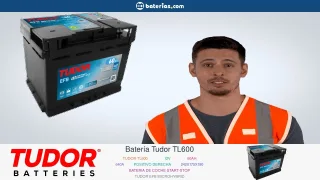
Tudor TL600 · Start-Stop battery 12V 60Ah 640A EFB
Specifications
| Brand | TUDOR |
|---|---|
| Part number | TL600 |
| Voltage (V) | 12 |
| Capacity (C20) | 60Ah (c20) |
| Cold cranking amps (EN) | 640A |
| Technology | EFB |
| Length | 242.00 mm |
| Width | 175.00 mm |
| Height | 190.00 mm |
Tudor TL600 12V 60Ah 640A is a dedicated Start-Stop battery with AGM/EFB technology. Withstands intensive cycling at traffic-light stops (hundreds of cranks per day), recharges quickly while driving and keeps comfort loads alive during long idle periods.
Why this Start-Stop battery?
- Designed for Start-Stopbuilt for the intensive cycling of modern cars
- 2 to 3 times longer lifevs fitting a cheap conventional battery
- Fast recoveryrecharges in minutes once the engine is running
Where it fits: the Tudor TL600 is one of our car batteries, belongs to our Tudor batteries and by capacity it sits among our 60Ah batteries.
Start-Stop battery Tudor TL600 EFB Microhybrid 60Ah 640A 12V
The Tudor TL600 Start-Stop battery offers 12 V, 60 Ah and 640 A of cold cranking current (EN) from the EFB Microhybrid range with EFB technology, and is built for cars with Start-Stop, regenerative braking and heavy electrical loads. It measures 242 × 175 × 190 mm and the positive terminal on the right, the format sought by anyone replacing a 60 Ah battery in Start-Stop cars.
In short: the Tudor TL600 (60 Ah, 640 A, 242 × 175 × 190 mm, positive terminal on the right). It is an EFB battery for cars with Start-Stop; if your car came with an AGM battery from the factory, always replace it with another AGM. Verified equivalent alternatives: Varta N60 and Exide EL600.
- Up to three times the cycles of a conventional battery.
- Compatible with regenerative braking and energy management (BMS).
- Withstands hundreds of starts a day without degrading.
- EFB technology: reinforced electrolyte for many more start cycles.
Vehicles compatible with the Tudor TL600
According to our database, the Tudor TL600 equips more than 342 vehicles from brands such as Citroën, Fiat, Volkswagen, Seat, Honda and Skoda, among others. It is a go-to option when you need a battery for a Citroën, Fiat or other models that use this same format. It also appears as a replacement in vehicles from Renault, Toyota, Peugeot, Nissan, Ford, Opel, Suzuki and Chevrolet, among other manufacturers. It covers 127 original-equipment references, one of the widest coverages in its format.
The Tudor TL600: EFB Microhybrid range and EFB technology
The TL600 is part of the Tudor EFB Microhybrid range. Choosing the right reference within the series comes down to capacity, dimensions and terminals: technology and quality are common to the whole family.
An EFB is a reinforced flooded battery: its plates retain the active material better and tolerate the cycling imposed by a simple Start-Stop system, at a lower cost than an AGM.
Dimensions, polarity and mounting
The Tudor TL600 is made in the 242 × 175 × 190 mm format and weighs 17.50 kg. The positive terminal on the right decides which side the cables end up on: it is the detail that causes most buying mistakes, so check it before ordering. Before replacing it, measure your current battery tray: if all three dimensions and the terminal positions match, the swap is direct and needs no adapters.
What Tudor does differently
Tudor is Spain's historic battery brand, today part of the Exide group. Its car, truck, motorcycle and leisure ranges are built with the same technology and controls as the group's original-equipment references. At baterias.com we work directly with the manufacturer or its official distributor: real stock, brand-new product and official warranty.
Care and maintenance
A charger with an EFB or smart conventional mode is enough; avoid the high-voltage modes intended for AGM. If the vehicle only does very short trips, a periodic maintenance charge with an AGM/EFB-compatible charger greatly extends its life.
Manufacturer's warranty
The Tudor TL600 comes with the manufacturer's official warranty. To keep it valid, always fit the same technology as the original battery (AGM or EFB) and register the replacement if your vehicle requires it.
Shipping, delivery and returns
Order before 6:00 pm with stock available and it leaves today: mainland Spain and Portugal receive it in 24-48 working hours, the islands and the rest of the EU in 3 to 5 days. You have 14 days to return it if it has not been installed, with free collection on the mainland, and shipment tracking by email.

Data sheet
-
BrandTUDOR
-
ReferenceTL600
-
ModelTUDOR EFB MICROHYBRID
-
Voltage (V)12
-
Length242.00 mm
-
Width175.00 mm
-
Height190.00 mm
-
TechnologyEFB
-
EAN3661024055680
-
Terminal layoutPositive terminal on the right
-
Cold cranking amps (EN)640A
-
Capacity (C20)60Ah (c20)
Specific References
-
EAN133661024055680
-
MPNTL600
Codes and references Tudor TL600
| Brand | Tudor · see all Tudor batteries |
|---|---|
| Manufacturer range | TUDOR EFB MICROHYBRID |
| Manufacturer part number (MPN) | TL600 |
| EAN-13 barcode | 3661024055680 |
| European case size (EN 50342-2) | L2 |
| Dimensions (length × width × height) | 242 × 175 × 190 mm (242x175x190) |
Comparison: Tudor TL600 vs equivalents
The Tudor TL600 is interchangeable with these equivalent references: N60 (Varta), EL600 (Exide). Higher-technology alternatives that can replace it: A8 (Varta), EK620 (Exide), TK620 (Tudor).
| Product | Specifications | Technology | Price |
|---|---|---|---|
|
|
12V 60Ah 640A | EFB | €84.70 |
|
|
12V 60Ah 640A | EFB | €91.40 |
|
|
12V 60Ah 640A | EFB | €76.80 |
|
|
12V 60Ah 680A | AGM Upgrade | €107.40 |
|
|
12V 62Ah 680A | AGM Upgrade | €94.40 |
|
|
12V 62Ah 680A | AGM Upgrade | €96.80 |
Equivalences verified by our technical team: same dimensions, polarity, capacity and CCA. Official manufacturer warranty on every option.
Other 60Ah batteries
We stock 42 models of 60 Ah to compare by price, technology and cold cranking: see all 60Ah batteries. Same size (242 × 175 × 190 mm): batteries of 242 × 175 × 190 mm.
Recommended accessories
Compatible vehicles
The Tudor TL600 fits 346 vehicles. Most searched below:
The 100 vehicles that most often fit the Tudor TL600
The Tudor TL600 fits 346 vehicles (1,245 engine versions), including the Abarth 500 / 595 / 695 1.4 (312.AXZ11) (121 kW / 165 CV) (2008–2025), Peugeot 208 I (CA_, CC_) 1.2 PureTech 82 (61 kW / 82 CV) (2012–2020), Renault Captur I (J5_, H5_) 0.9 TCe 90 (66 kW / 90 CV) (2013–2025) and Honda HR-V (RU) 1.5 (RU1) (96 kW / 130 CV) (2014–2025).
Show the table: make, model, engine and years (100 vehicles)
| Make | Model | Engine | Years |
|---|---|---|---|
| Abarth | 500 / 595 / 695 | 1.4 (312.AXZ11) (121 kW / 165 CV) | 2008–2025 |
| Peugeot | 208 I (CA_, CC_) | 1.2 PureTech 82 (61 kW / 82 CV) | 2012–2020 |
| Renault | Captur I (J5_, H5_) | 0.9 TCe 90 (66 kW / 90 CV) | 2013–2025 |
| Honda | HR-V (RU) | 1.5 (RU1) (96 kW / 130 CV) | 2014–2025 |
| Mitsubishi | Mirage / Space Star VI Hatchback (A0_A) | 1.2 (A03A) (59 kW / 80 CV) | 2012–2025 |
| Dacia | Logan MCV II | TCe 90 (K8M1, K8MA, K8AC) (66 kW / 90 CV) | 2013–2025 |
| Volkswagen | UP! (121, 122, BL1, BL2, BL3, 123) | 1.0 GTI (85 kW / 115 CV) | 2011–2025 |
| Volkswagen | Golf VII (5G1, BQ1, BE1, BE2) | 1.2 TSI (77 kW / 105 CV) | 2012–2021 |
| Volkswagen | Golf VII (5G1, BQ1, BE1, BE2) | 1.2 TSI (63 kW / 86 CV) | 2012–2021 |
| Peugeot | 2008 II (UD_, US_, UY_, UJ_, UR_, UC_) | e-2008 (UKZKXZ) (100 kW / 136 CV) | 2019–2025 |
| Peugeot | 2008 I (CU_) | 1.2 PureTech 82 (61 kW / 82 CV) | 2013–2025 |
| Citroën | C3 / C3 Origin III (SX) | 1.2 PureTech 82 (61 kW / 83 CV) | 2016–2025 |
| Fiat | Grande Punto (199_) | 1.2 (51 kW / 69 CV) | 2005–2025 |
| Seat | Ibiza V (KJ1, KJG) | 1.0 TSI (81 kW / 110 CV) | 2017–2025 |
| Peugeot | Expert Bus (V_) | 1.5 BlueHDi 100 (75 kW / 102 CV) | 2016–2025 |
| Fiat | 500 (312_) | 1.3 D Multijet (312AXE1A) (70 kW / 95 CV) | 2007–2025 |
| Fiat | Grande Punto (199_) | 1.3 D Multijet (56 kW / 76 CV) | 2005–2025 |
| Fiat | 500 (312_) | 1.3 D Multijet (312AYA1A) (57 kW / 78 CV) | 2007–2025 |
| Opel | Grandland / Grandland X (A18, P1UO) | 1.6 Turbo Hybrid (165 kW / 224 CV) | 2017–2025 |
| Citroën | C5 Aircross (A_) | 1.6 Hybrid 225 (A45GFR) (165 kW / 224 CV) | 2018–2025 |
| Fiat | 500 C (312_) | 1.2 (312CXA1A, 312AXA1A) (51 kW / 69 CV) | 2009–2025 |
| Fiat | 500 (312_) | 1.2 LPG (312AXA1A) (51 kW / 69 CV) | 2007–2025 |
| Citroën | C3 II (SC_) | 1.2 PureTech Flex (66 kW / 90 CV) | 2009–2025 |
| Ford | KA (RU8) | 1.2 (51 kW / 69 CV) | 2008–2016 |
| Peugeot | 3008 II SUV (MC_, MR_, MJ_, M4_) | Hybrid (133 kW / 181 CV) | 2016–2025 |
| Peugeot | 3008 II SUV (MC_, MR_, MJ_, M4_) | Hybrid 180 (M4DGLU) (132 kW / 179 CV) | 2016–2025 |
| Dacia | Sandero II | TCe 90 (B8M1, B8MA, B8AC) (66 kW / 90 CV) | 2012–2025 |
| Peugeot | 2008 I (CU_) | 1.2 PureTech 110 (84 kW / 114 CV) | 2013–2025 |
| Fiat | Punto EVO (199_) | 1.3 D Multijet (68 kW / 93 CV) | 2008–2025 |
| Suzuki | Vitara (LY) | 1.6 (85 kW / 116 CV) | 2015–2025 |
| Fiat | 500 (312_) | 1.4 (312AXC1B, 312CXC1B) (74 kW / 100 CV) | 2007–2025 |
| Fiat | 500 (312_) | 1.2 (312AXA1A) (51 kW / 69 CV) | 2007–2025 |
| Skoda | Kamiq (NW4) | 1.0 TSI (70 kW / 95 CV) | 2019–2025 |
| Citroën | C2 (JM_) | 1.4 16V (65 kW / 90 CV) | 2003–2017 |
| Seat | Arona (KJ7, KJP) | 1.0 TSI (85 kW / 115 CV) | 2017–2025 |
| Seat | Arona (KJ7, KJP) | 1.0 TSI (81 kW / 110 CV) | 2017–2025 |
| Nissan | Note (E12) | 1.2 (58 kW / 79 CV) | 2012–2025 |
| Peugeot | 3008 II SUV (MC_, MR_, MJ_, M4_) | Hybrid (165 kW / 224 CV) | 2016–2025 |
| Seat | Ibiza IV (6J5, 6P1) | 1.4 (63 kW / 85 CV) | 2008–2017 |
| Cupra | Formentor (KM7, KMP) | 1.4 e-Hybrid VZ (180 kW / 245 CV) | 2020–2025 |
| Nissan | Note (E12) | 1.2 DIG-S (65 kW / 88 CV) | 2012–2025 |
| Volkswagen | T-ROC (A11, D11) | 1.5 TSI (110 kW / 150 CV) | 2017–2025 |
| Nissan | Qashqai III (J12) | 1.5 VC-T e-Power (140 kW / 190 CV) | 2021–2025 |
| Fiat | Grande Punto (199_) | 1.4 (199AXB11, 199AXB1A, 199BXB1A, 199AXL1A) (57 kW / 77 CV) | 2005–2025 |
| Nissan | Note (E12) | 1.2 (59 kW / 80 CV) | 2012–2025 |
| Dacia | Sandero III | 1.0 TCe 90 (67 kW / 91 CV) | 2021–2025 |
| Seat | Ateca (KH7, KHP) | 1.0 TSI (81 kW / 110 CV) | 2016–2025 |
| Fiat | Tipo Estate (356_, 357_) | 1.4 (356WXA1B) (70 kW / 95 CV) | 2016–2025 |
| Volkswagen | Golf VII (5G1, BQ1, BE1, BE2) | 1.5 TSI (110 kW / 150 CV) | 2012–2021 |
| Renault | Megane IV Hatchback (B9A/M/N_) | 1.2 TCe 130 (B9MR) (97 kW / 130 CV) | 2015–2025 |
| Peugeot | 208 II (UB_, UP_, UW_, UJ_) | e-208 (100 kW / 136 CV) | 2019–2025 |
| Skoda | Karoq (NU7, ND7) | 1.5 TSI (110 kW / 150 CV) | 2017–2025 |
| Fiat | Punto EVO (199_) | 1.3 D Multijet (62 kW / 84 CV) | 2008–2025 |
| Volkswagen | Polo VI (AW1, BZ1, AE1) | 1.0 TSI (70 kW / 95 CV) | 2017–2025 |
| Seat | Ibiza IV (6J5, 6P1) | 1.6 (77 kW / 105 CV) | 2008–2017 |
| Volkswagen | UP! (121, 122, BL1, BL2, BL3, 123) | 1.0 (55 kW / 75 CV) | 2011–2025 |
| Honda | Jazz III (GE_, GG_, GP_, ZA_) | 1.3 HYBRID (GP1) (75 kW / 102 CV) | 2007–2025 |
| Fiat | Grande Punto (199_) | 1.3 D Multijet (199.AXD11, 199.AXD1A, 199.AXD1B,... (66 kW / 90 CV) | 2005–2025 |
| Honda | HR-V (RU) | 1.5 i-VTEC (RU1) (134 kW / 182 CV) | 2014–2025 |
| Citroën | Berlingo Multispace (B9) | 1.2 PureTech 110 (81 kW / 110 CV) | 2008–2025 |
| Fiat | Punto EVO (199_) | 1.3 D Multijet (51 kW / 69 CV) | 2008–2025 |
| Fiat | 500 C (312_) | 1.4 (312CXC1B, 312AXC1B) (74 kW / 100 CV) | 2009–2025 |
| Mitsubishi | Lancer Viii Sportback (CX_A) | 1.6 MIVEC (86 kW / 117 CV) | 2007–2025 |
| Fiat | Punto EVO (199_) | 1.2 (51 kW / 69 CV) | 2008–2025 |
| Honda | CR-V V (RW_, RT_) | 2.0 i-VTEC AWD (RW4) (110 kW / 150 CV) | 2016–2025 |
| Volkswagen | Polo V (6R1, 6C1) | 1.2 TSI (81 kW / 110 CV) | 2009–2022 |
| Fiat | Tipo Estate (356_, 357_) | 1.4 (356WXF1B) (88 kW / 120 CV) | 2016–2025 |
| Suzuki | Vitara (LY) | 1.4 T (APK414) (103 kW / 140 CV) | 2015–2025 |
| Citroën | C4 Cactus | 1.2 PureTech 130 (96 kW / 131 CV) | 2014–2025 |
| Fiat | Grande Punto (199_) | 1.3 D Multijet (55 kW / 75 CV) | 2005–2025 |
| Skoda | Karoq (NU7, ND7) | 1.5 TSI 4x4 (110 kW / 150 CV) | 2017–2025 |
| Peugeot | 3008 II SUV (MC_, MR_, MJ_, M4_) | Hybrid4 (M45GBU) (220 kW / 299 CV) | 2016–2025 |
| Mitsubishi | ASX (GA_W_) | 1.6 MIVEC (GA1W) (86 kW / 117 CV) | 2009–2025 |
| Volkswagen | Polo V (6R1, 6C1) | 1.0 TSI (81 kW / 110 CV) | 2009–2022 |
| Fiat | 500L (351_, 352_) | 1.3 D Multijet (199.LYM11, 199.LYM1A) (70 kW / 95 CV) | 2012–2025 |
| Volkswagen | T-ROC (A11, D11) | 1.0 TSI (85 kW / 115 CV) | 2017–2025 |
| Fiat | Panda VAN (312_, 519_) | 1.2 LPG (312CXA1A) (51 kW / 69 CV) | 2012–2025 |
| Fiat | 500 C (312_) | 0.9 (312AXM1B) (77 kW / 105 CV) | 2009–2025 |
| Fiat | 500 C (312_) | 0.9 (312AXP1A) (44 kW / 60 CV) | 2009–2025 |
| Fiat | Qubo (225_) | 1.3 D Multijet (225CXB1A, 225AXB1A, 225CXB11, 225AXB11,... (55 kW / 75 CV) | 2008–2025 |
| Skoda | Fabia III (NJ3) | 1.0 TSI (81 kW / 110 CV) | 2014–2021 |
| Dacia | Sandero II | TCe 90 LPG (B8M1) (66 kW / 90 CV) | 2012–2025 |
| Renault | Captur II (HF_) | TCe 130 (HFMF) (96 kW / 131 CV) | 2020–2025 |
| Skoda | Octavia IV Combi (NX5, PV5) | 1.4 TSI RS iV (180 kW / 245 CV) | 2019–2025 |
| Renault | Logan/Stepway II (L8_) | 1.6 (83 kW / 113 CV) | 2012–2025 |
| Suzuki | Splash (EX) | 1.2 VVT (A5B412) (69 kW / 94 CV) | 2008–2025 |
| Seat | Arona (KJ7, KJP) | 1.6 TDI (85 kW / 115 CV) | 2017–2025 |
| Seat | Ibiza V (KJ1, KJG) | 1.0 TSI (70 kW / 95 CV) | 2017–2025 |
| Fiat | Idea (350_) | 1.8 (81 kW / 110 CV) | 2003–2025 |
| Lancia | Ypsilon (312_) | 1.2 Bi-fuel (312.YXA1A) (51 kW / 69 CV) | 2011–2025 |
| Fiat | Doblo Bus (263_) | 1.6 D Multijet (263AXH1A, 263AXL11, 263AXH1B) (66 kW / 90 CV) | 2009–2023 |
| Honda | City VI Saloon (GM4, GM5, GM6, GM9, GM7) | 1.5 i-VTEC (GM6) (88 kW / 119 CV) | 2013–2025 |
| Suzuki | SX4 S-Cross (JY) | 1.4 T (AKK414) (103 kW / 140 CV) | 2013–2025 |
| Abarth | 500 / 595 / 695 | 1.4 (312.AXY11, 312.AXY1A) (107 kW / 145 CV) | 2008–2025 |
| Volkswagen | Polo VI (AW1, BZ1, AE1) | 1.0 (55 kW / 75 CV) | 2017–2025 |
| Peugeot | 208 II (UB_, UP_, UW_, UJ_) | 1.2 PureTech 130 (96 kW / 131 CV) | 2019–2025 |
| Fiat | 500 C (312_) | 1.3 D Multijet (312CXE1A, 312AXE1A) (70 kW / 95 CV) | 2009–2025 |
| Nissan | Juke (F15) | 1.6 (86 kW / 117 CV) | 2010–2019 |
| Opel | Corsa F (P2JO) | 1.2 (68) (96 kW / 131 CV) | 2019–2025 |
| Toyota | Yaris (_P9_) | 1.4 D-4D (NLP90_, NLP90R) (66 kW / 90 CV) | 2005–2014 |
Fitting it yourself? Step-by-step guide to replacing the battery →
Frequently asked questions
Is the Tudor TL600 an EFB battery? When is EFB used?
Yes. The TL600 is an EFB (Enhanced Flooded Battery): flooded lead-acid reinforced with plate additives. Withstands more cycles than a conventional but fewer than an AGM. Fitted to cars with basic Start-Stop (no regenerative braking). More affordable than an equivalent AGM, lifespan 4-6 years.
Is the Tudor TL600 battery suitable for Start-Stop?
Yes. As EFB technology it is designed for Start-Stop vehicles. EFB batteries cover basic Start-Stop (no regenerative braking). EFB is recommended for basic Start-Stop; AGM is recommended when regenerative braking is also present, thanks to its higher cycle capability. It works straight out of the box — on most modern vehicles registering the battery via OBD is recommended so the alternator automatically applies the optimal charging profile.
How is the Tudor TL600 battery fitted in a Start-Stop car?
In most cars it fits in 15-30 minutes with a 10 mm wrench; if the battery is under the seat or in the boot the time can double. See the step-by-step guide on our blog. Quick summary: 1) switch off the engine and remove the key; 2) locate the original battery (engine bay, boot or under seat); 3) disconnect the negative (−) terminal first, then the positive (+); 4) loosen the hold-down clamp and remove the old battery; 5) fit the new one in the same orientation — with positive on the right match the polarity shown on the product sheet; 6) connect the positive (+) first, then the negative (−). On cars with Start-Stop or BMS, register the battery via OBD so the alternator applies the correct charging profile. Also, the negative terminal usually carries a battery sensor (IBS): undo the cable at the terminal nut without removing the sensor. Always replace it with the same technology (AGM or EFB) or higher: a conventional battery wears out within months with Start-Stop.
How long does the Tudor TL600 battery last?
Expected lifespan of the Tudor TL600 is 4 to 6 years in basic Start-Stop car use. In cold regions it drops slightly due to cold-start stress; in very hot regions it also drops because of electrolyte evaporation. To extend its life: avoid deep discharges (headlights on with engine off), have the alternator checked yearly, and keep the battery clean and properly secured.
What are the dimensions of the Tudor TL600 battery?
Dimensions (length × width × height) are 242×175×190 mm — also written as 242x175x190 mm and correspond to the European L2 case size — following the European DIN standard. Always measure the space in your car before buying: even one extra millimetre can prevent the hold-down clamp from closing. The height shown includes the terminals.
What polarity does the Tudor TL600 battery have?
Polarity: positive on the right. To identify it, place the battery in front of you with the terminals facing you and check which side the positive (+, marked with a red ring) is on. Before buying, verify the polarity matches your current battery: switching polarity forces longer cables or system reconfiguration, with short-circuit risk.
Will the Tudor TL600 battery fit my car?
Three options to confirm: 1) enter your number plate in the finder (DGT/DVLA/KBA auto-detect your model and engine); 2) check the "Compatible vehicles" tab on this page, where we list every vehicle verified by our technical team; 3) if you cannot find your model, message us on WhatsApp with brand, model, engine and year — we reply during business hours (Mon–Fri 10:00–13:30 and 16:40–18:00 (Spanish time, CET)). The TL600 fits 346 verified vehicle versions in our database.
Which batteries are equivalent to the Tudor TL600?
Directly interchangeable batteries (same dimensions, same polarity, same Ah and CCA) are the OEM equivalents from leading brands: Bosch, Tudor, Exide and, depending on the model, Banner or Yuasa. Exact equivalence depends on technology — an EFB cannot be replaced with a conventional battery in Start-Stop cars. See the "Equivalents" section to view recommended options at the same performance level.
Is this EFB enough for my Start-Stop car?
An EFB (Enhanced Flooded Battery) is a flooded lead-acid battery reinforced with plate additives (carbon and polyethylene) and thicker grids. It withstands twice the cycles of a conventional battery and handles deep discharges better, but less than an AGM. It is the original fitment on cars with basic Start-Stop (no regenerative braking): Renault Energy TCe, Peugeot/Citroën PureTech, Fiat MultiAir, Hyundai/Kia ISG, Ford EcoBoost. If your car came with EFB from the factory, this is the correct battery — upgrading to AGM is optional (marginal improvement). If it came with AGM, EFB may fall short: better fit AGM. The Tudor TL600 is original and meets EN 50342-6.
Will my car recognise the new battery automatically?
On most cars it is not strictly necessary — the alternator detects the new battery and adapts the charge automatically. It is recommended to register the battery via OBD so that the alternator applies the optimal charging profile from the first minute and extends the battery life as much as possible (especially on brands with sophisticated BMS: BMW, Mercedes, Audi, Volvo, Land Rover). Any workshop with an OBD scanner (~10-15 € labour) does it in 5 minutes. DIY apps: VCDS / Carista (VAG), Bimmercode (BMW), iCarsoft. If you do not register, the car will still start correctly — the alternator just takes a few days to adjust the profile. The Tudor TL600 ships factory-charged at 80-90% so you can use it straight after fitting.
The top-rated online battery store in Spain
-
Audited by Trustpilot, no filters, no edits. The top-rated battery store in Spain.
Trustpilot · verified, no filters
-
Official Varta distributor
Official Varta wholesale distributor. 100% genuine batteries, recently manufactured, best price and no middlemen.
World’s best-selling battery brand
-
+100,000 satisfied customers
More than 100,000 customers already trust baterias.com — and recommend us to their friends and family.
They trust us and recommend us
Choose trust, choose quality, choose baterias.com.
You might also like